“You kill your film several times, mostly by talking about it. A film is a dream. You kill it writing it down, you kill it with a camera; the film might come back to life for a moment or two when your actors breathe life into it- but then it dies again, buried in the film cans. Mysteriously, sometimes, in the editing room, a miracle happens when you place one image next to another so that when, finally, an audience sits in the dark, if you’re lucky… the dream flickers back to life again. That’s why I’m secretive.”
This was a quote from Guido Contini (Daniel Day-Lewis) in Nine, which I saw a short while ago. While he was referring to why he doesn’t like to discuss his films publicly, its also a powerful comment on the tragic process of having a perfect image in your mind painfully destroyed before you for all the world to judge as your original vision.
It reminded me of when I went to see a SAG screening years ago of Shadow of the Vampire, directed by E Elias Merhige, who had this look on his face when he sat on the stage answering questions that could only be described as a complacent smile, covering extreme disappointment at what his film could have been. I’ve seen that look in different forms on many different directors. Merhige had it, Daniel Day-Lewis had it in his character in Nine, and all of my favorite directors seem to wear it as a permanent mask. They seem so wise, deeply disturbed, and simultaneously grateful to be in their current position. I wanted to know what was behind that façade of complacency.
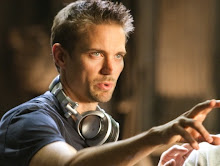
I had the privilege of directing my first feature/web-series, The Bannen Way, for Sony this past year. I was proud of the script I created with my partner, Mark Gantt (along with the invisible force of producer, Bailey Williams). The original visions in my head were glorious. And we had a plan of execution. I affectionately referred to this project as “my baby”, knowing full-well the theoretical sacrifices that are made by directors on their “first-born” and how it affects them; that notion started as a naïve smile on my bright-eyed face as I set out to prove you can get everything you want as an artist and still make everyone happy…
And then I witnessed each day, throughout pre-production, production, and post-production, as the harsh realities of film-making on a budget set in, and tore my baby limb from limb…
It was at the culmination of these moments when I couldn’t watch my project any more that I fled to the theatre to watch something else- anything else- and I stumbled upon Nine. This opening monologue touched me to my very core; I started to shake. It was the epitome of what I had been feeling for the past several months.
It brought me back to another quote I had heard earlier on in the process (that’s what happens when you have A.D.D., by the way, you are constantly brought back to previous moments. Welcome to my world)…
“You have to sacrifice certain moments so that others may live.” Stated by my extremely talented DP, Roger Chingirian, he delivered it with such feigned importance- as if pretending the phrase was being created for the first time, though we mutually laughed at how tired that saying is. It was his attempt, without being too significant, to get us to cut down the script to make the shoot more manageable. But at that point I was done making sacrifices…
After all, in pre-production, I had already given up the parkour sequence…
Oh, the parkour sequence. If you don’t know what parkour (or parcour) is then rent Casino Royale and watch the opening action sequence. Or watch any portion of District 13. For now, just know that it that centers around the concept of getting from Point A to Point B as quickly and efficiently as possible. Its fun, its energetic, and its amazing to watch.
I had been taking classes on this new-ish craze as I fully planned on integrating it into The Bannen Way. The box that our hero, Neal Bannen, is desperately trying to recover is stolen by a group of these parkour thugs late in Act 2, headed by their French leader, Marcel. In Act 3, Bannen is to outwit them and run away with the box, only to be chased by twenty of these athletic geniuses.
My goal was to be on the cutting edge of anything like this before it became a well-known concept by the masses. And it was perfect trailer fodder…
Alas, we couldn’t afford it for our film and the ship has officially passed on any ingenuity it may have brought as there’s a big-budget movie called Parkour coming out and they’re doing the sequel to District 13; the market’s already becoming as over-saturated with parkour as vampires are these days.
This was the first time I experienced the mourning process over something that was in my head that would never end up on screen. My vision of how the story flowed, and the type of movement it would elicit had to be compromised because we simply couldn’t afford it.
Let me be clear that Sony was right to eliminate that first as we all had another goal to keep in mind: to make high-quality programming on the web that could actually make money. And if they funded every idea that came to Mark and me then they’d be broke. Our initial job was to dream up the best possible story and it was then, collectively, all our jobs to cut out what wasn’t cost-effective.
Our script got cut down to a point where we felt that the story would seriously be sacrificed if we got rid of any more. All car chases were gone. Many characters were eliminated. It was a real challenge keeping the integrity of the core of our story together. We were all finally convinced that what we had was doable, though extremely challenging to execute.
But there were many more sacrifices to be made in Production. Time was always a factor. And many of my “specialty” shots had to go. There were times we had to do the bare minimum to tell the story, Roger and I eking out as much style as we could within those constraints. We always had to consider how long it would take to light in a different direction so a lot of my “stylistic angles” were shelved in order to get through the day. It was heart-breaking, but totally necessary.
Granted, these kinds of constraints are not uncommon, though I was told on numerous occasions that if one could get through this then they could get through anything. And it didn’t stop there…
In post, dialogue that I thought was essential in defining a character was left on the virtual cutting floor so that we could keep the film at 90 minutes in order to sell it easier on DVD. I’m really into shows like Mad Men and I’m making my way through The Wire right now. They’re both examples where characters are given space to breathe and live in the space. Nothing feels rushed. It sets a tone. It positions the audience in such a way that creates a tension that can’t be attained by hastening through moments.
In our case, we simply needed the movie to be shorter. That meant chopping dialogue that everyone seemed to like; that meant cutting out space between lines that could have informed the audience about character; that surprisingly didn’t mean cutting out any scenes, although we did stylistically combine three scenes at one point to move the story along- which is an interesting by-product of creating ideas within constraints that wouldn’t have come about otherwise; Necessity being the mother of invention and all that…
As much as I pleaded with our development guys to keep the film longer, their hands were tied as well. As much as they wanted to give the movie everything it deserved, the reality of making a movie was rearing its ugly head. I was to be no exception to this rule. Thankfully my brilliant editor, Zack Arnold, was prepared for such limitations and helped me make compromises that appeased all parties.
Every element of filmmaking was affected by these constraints: Sound, lighting, time with actors, you name it…
But in a way that’s the beauty of it- the fleeting nature of filmmaking. Its about creating as many moments as possible. When those moments actually occur on screen it makes them all the more sweet because of the difficult spirit of this craft. Its not reserved for artistic endeavors though.
Athletes can train their entire lives for their big shot and have it taken away from them at the last second. As a former professional runner (when I used to go by my given name, Jess Strutzel) I wanted nothing more than to make the Olympic Team in the 800 meters. In 2000, I was in the lead in the final round with 100 meters to go only to physically fall apart and get passed by the field, missing the Olympic Team by 1 second…
Trying again in 2004, my first race of the season marked the fastest time in America that year; there was nothing that could stand in my way… Until I proceeded to fall in a local 5K, skinning up my knee, which I trained through. Then I got a virus, which slowed me down- but I continued to train through it. And finally I got a stress fracture in my foot due to over-training, which I couldn’t overcome and my Olympic Dreams were shelved forever.
That’s when I finally turned my full attention to filmmaking. Thankfully in this craft, its not all-or-nothing. You just try to create as many of those magical moments as possible- and strive to fulfill that original vision to the best of your ability.
While watching the rest of Nine, I realized that this happens to every director. For the most part, the audience never sees the imperfections but the director inevitably cringes at painfully obvious flaws, missed opportunities, and miniscule details that could have improved less-than-perfect moments.
This tragic, yet beautiful, reality sank in; and, in retrospect, as much as I like to keep that “divine dissatisfaction” in everything I do- that innate desire that keeps me striving for something better, I took a calming breath… And I whispered quietly to myself…
“I’m proud of my first feature film.” And a gentle, complacent smile settled on my somewhat-wiser face.
~ JW